
Thanks to Rob for finding the ABC TV video clip from 25 May 2026 that is short, sharp and to the point, discussing the Albo/Chalmers Australian Federal post-Budget sales disaster and its impact on home ownership and housing investment.
Alan Kohler, as I have mentioned before, is a great presenter of graphs.
And just in, supporting his analysis, we see that Rosamund Pike was distracted by a rude audience member she saw texting during her performance on stage.

Photo credit. Found by Rob in The Guardian, but look out for their data collection on you.
On 1 June 2026, Alan Kohler wrote another article1 and discussed it live on the 24-hour ABC TV News Channel. Part of a series on the Federal Budget and changes to Taxes impacting Negative Gearing and Capital Gains Tax (CGT).
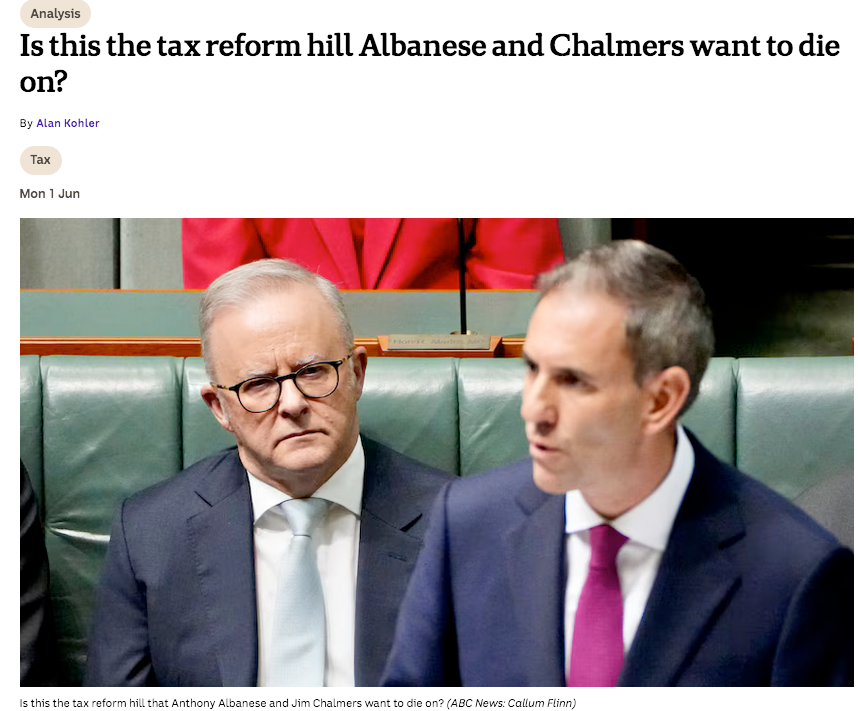
Here is a snip:
It’s not as if it will make much difference to the structural budget deficit.
The amounts Treasury plugged into the forward estimates for the change to CGT and the limiting of negative gearing to new dwellings are $1.35 billion in 2028-29 and $2.28 billion in 2029-30; $3.6 billion over five years.
So … not much, not quick.
Treasury doesn’t reveal how much of that money it expects from the negative gearing change and how much from CGT, and nor does it say how much of the extra CGT money it expects to come from housing and how much from business.
It probably doesn’t know, no-one does, but at a guess I’d say most of it comes from negative gearing and business paying more CGT.
Compare the guessed “savings” to the budget to the $368,000,000,000 figure plucked out of the air as the price of the AUKUS submarine Warmongering fiasco.
Immigration Falling, House Prices Flatline
Alan Kohler concludes with:
immigration is falling and housing starts are rising as a result of the housing accord (albeit less than the target), which should result in a surplus of housing for a while at least.
That, along with higher interest rates, is already causing house prices to fall in Melbourne and Sydney, and slow elsewhere.
The effective increase in CGT and removal of negative gearing for established dwellings should accelerate it.
At best, house prices will probably stay roughly where they are for a long time, maybe even two decades as Macquarie predicts.
The good news is that this will make housing more affordable.
The bad news is that it will be a terrible investment, and a nightmare for those who have stretched themselves to invest in it.
GST as an alternative?
I was disturbed to see Alan Kohler telling us of a push from some quarters to double the Goods and Services Tax (GST) from 10% to 20%.
In 1993, I took time out to run as a Federal Labor candidate and the introduction of the regressive GST proposed by the Liberal Party was prevented by the election of the Keating government.
Kohler does not have my support for this argument:
The most commonly suggested reform is a big shift away from income taxes and towards consumption and resources taxes.
It’s not so much the top marginal income tax rate of 47 per cent that’s the problem, which is about the OECD median of 45 per cent, it’s the salary at which it starts — $190,000, or 1.7 times average earnings.
That is close to half the OECD median of 3.1 times average earnings.
Australia’s consumption tax, on the other hand, is exactly half the OECD average of 20 per cent.
Economists have argued that there is a case for Australia to increase the GST rate, and there is a campaign to increase taxes on exported LNG. The proceeds could be applied to lowering income taxes across the board.
There is also an argument that the federal government should no longer give the GST revenue to the states and the AMA has suggested that it take over all health spending as an offset.
That would have the added benefit, says the AMA, of bringing primary care (Medicare) and hospital funding under one roof. It would also end the argument about who takes care of the “Thriving Kids” being removed from the NDIS.
Now that would be a worthwhile tax reform and would burnish the legacies of both Albanese and Chalmers. If that reform was ever going to be done, this term would be the time.
https://www.abc.net.au/news/2026-06-01/capital-gains-tax-negative-gearing-housing-chalmers-albanese/106742204


